
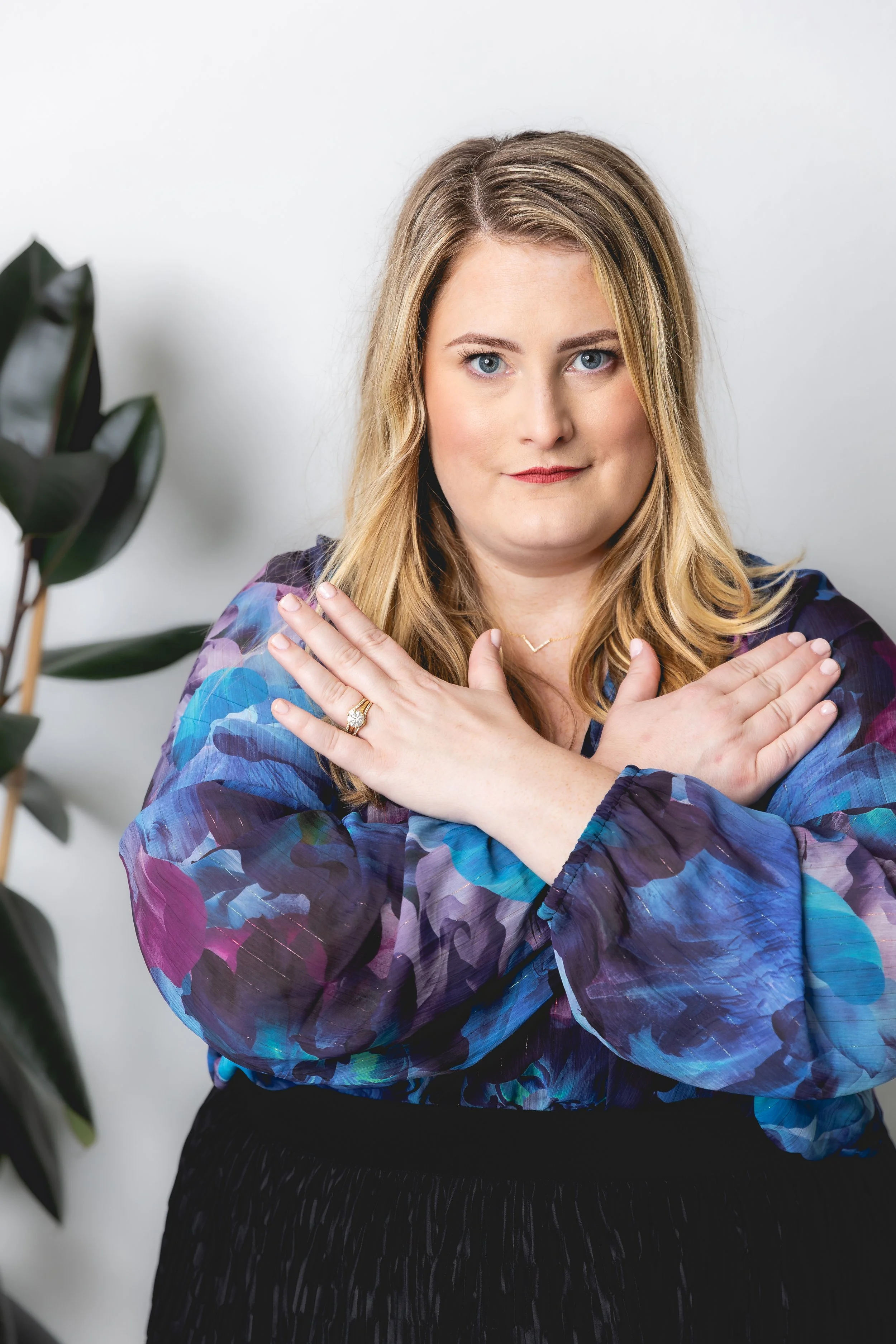
Hi, I’m Cecelia.
I’m a Licensed Clinical Social Worker, couples therapist, and EMDRIA Certified EMDR Therapist specializing in trauma, relationships, and the ways our experiences can continue to shape how we feel, function, and connect with others.
I believe good therapy requires more than knowing the right interventions. You should feel comfortable with the person sitting across from you, understand the treatment you’re receiving, and have a meaningful voice in where your therapy goes.
My goal is to help you better understand yourself and your experiences, recognize patterns that may be keeping you stuck, and find a way forward that makes sense for you.

How I Show Up as a Therapist
I'm a relational therapist, which means the relationship we build is an important part of the work we do together. My initial priority is helping you feel comfortable, understood, and safe enough to be honest—even when what you're bringing into therapy is complicated, messy, or difficult to talk about.
At this point in my career, I've heard a lot, and it takes quite a bit to shock me. That's not because I take your experiences lightly—it means you don't have to clean up your story, find the “right” words, or worry about making me uncomfortable. You get to bring the messy parts, too.
You don't have to clean up your story,
find the “right” words, or worry about
making me uncomfortable.
I’m engaged and collaborative in session. I won’t simply sit back and ask, “How does that make you feel?” for 50 minutes. I ask questions, provide education, help you make connections, and offer feedback when I think it may be helpful. Sometimes that means gently pointing out something that may be difficult to hear. I believe those conversations can happen while still being compassionate, respectful, and firmly on your side.
One of my favorite parts of this work is helping people understand why they do the things they do. A behavior or coping strategy that frustrates you today may have once been an incredibly effective way of protecting yourself, maintaining a relationship, or getting through a difficult environment. Understanding where a pattern came from can help us approach it with curiosity rather than judgment—and decide whether it still deserves a place in your life.
I also believe you deserve to understand your treatment. I’m thorough in explaining the interventions I recommend, the research behind them, and why I think they may be useful for you. Therapy should be something we do together, not something that is done to you. Your autonomy and ability to make informed choices about your care matter deeply to me.
And yes, there is usually room for humor. Therapy can involve incredibly serious work without every moment in the therapy room having to feel heavy.
Why Trauma Work?
I've always been curious about people—why we do what we do, how our experiences shape us, and how the families, communities, and systems around us influence who we become.
Long before becoming a therapist, I studied political science, sociology, and criminology as an undergraduate and later continued studying sociology at the graduate level. I genuinely loved the research and the opportunity to better understand people and the world around them. In many ways, I still do. But eventually, I realized something was missing. I didn't only want to study people's experiences—I wanted the opportunity to make a meaningful difference in their lives.
During my studies, I worked with adolescents in a behavioral health setting and volunteered with people who were incarcerated and those on probation or parole. Hearing people's stories made it impossible to ignore how profoundly trauma, relationships, environment, and larger systems can shape the course of someone's life. I became increasingly interested not only in understanding why people develop certain patterns, but in what actually helps people heal and create change.
That curiosity ultimately led me to social work and to Widener University, where I specifically chose a Master of Social Work program that also offered a graduate certificate in Social Work and Trauma Practice.
During my second year of graduate school, I began working with veterans as a clinical social work intern at the Philadelphia VA. That experience would ultimately shape much of my career. I went on to spend more than eight years with the Department of Veterans Affairs in a variety of clinical and program leadership roles.
My years serving veterans deepened my understanding of trauma in ways that no classroom ever could. I saw how its effects can reach far beyond memories of what happened—into relationships, physical and mental health, work, identity, and the ways we learn to connect with or protect ourselves from other people. I also came to understand how profoundly our closest relationships can affect our well-being and recovery from difficult life experiences.
While still working at the Philadelphia VA, I opened my private therapy practice and began pursuing advanced training in EMDR. Private practice gave me the opportunity to deepen my clinical work with trauma while continuing to learn from the complex experiences of the veterans and families I served within the VA.
In 2023, I relocated to Florida and transferred to Bay Pines VA to serve as the Intimate Partner Violence Assistance Program Coordinator. The role brought together so many of the threads that had shaped my career—trauma, relationships, healthcare, education, and systems-level work—and allowed me to focus more deeply on intimate partner violence, sexual trauma, domestic violence, and relationship health.
What began as a curiosity about why people become who they are ultimately became something much more meaningful to me: helping people understand how their experiences have shaped them—and supporting them as they decide what they want the next part of their story to look like.
How Couples Work Found Me
I wish I had a profound story about why I became a couples therapist, but the truth is that I found my way into couples work somewhat by accident—and quickly realized how much I loved it.
Relationships are the backbone of our lives, and I find it deeply meaningful to help people build healthier, more fulfilling connections with the people they love most. I am particularly drawn to working with couples where one or both partners has experienced complex trauma. What helped someone survive earlier relationships or environments can sometimes show up very differently in an intimate partnership. Protective patterns around conflict, vulnerability, trust, closeness, or emotional safety may have once served an important purpose but can create distance or disconnection in a relationship today.
Couples therapy gives us an opportunity to understand those patterns rather than simply deciding who is right or wrong. My goal is to help each partner better understand themselves and one another, recognize what is happening beneath recurring conflicts, and develop healthier ways of connecting.
The work I do with couples tends to be deep and reflective. It requires a willingness from both partners to be honest, curious about their own contributions to the relationship, and open to looking beyond surface-level disagreements.
Experience Across Mental Health and Healthcare
Over more than eight years with the Department of Veterans Affairs, I had the opportunity to work across a broad range of settings, from hospital-based care to community-based programs. I worked extensively with Veterans experiencing serious mental illness, trauma, homelessness and housing instability—including through both direct clinical work and program leadership—as well as chronic and serious medical conditions and complex psychosocial needs.
Clinical & Leadership Experience
My work with Veterans experiencing homelessness ranged from providing direct clinical services and case management through HUD-VASH to helping Veterans obtain and maintain permanent housing. I later moved into program leadership, overseeing contracted residential programs in Philadelphia that served Veterans with complex mental health, medical, and psychosocial needs. That work involved program operations, contracts and acquisitions, and oversight of a multimillion-dollar program.
My clinical experience extended well beyond homelessness. I worked extensively with Veterans experiencing serious mental illness, trauma, and chronic or serious medical conditions. I also supported spouses, partners, family members, and caregivers navigating serious illness, end-of-life and long-term care, mental health concerns, and other major life transitions.
Throughout my VA career, I provided social work coverage in emergency medicine, inpatient medical units, and inpatient psychiatry, collaborating closely with professionals across medical and mental health specialties. These experiences deepened my understanding of how physical health, mental health, relationships, and the circumstances of our lives can influence one another.
Trauma & Relationship Health
My interest in relationship health grew alongside my trauma work. At the Philadelphia VA, I became a certified Strength at Home Therapy Provider, facilitating trauma-informed interventions focused on relationship conflict and aggression, the impact of trauma on intimate relationships, and building healthier relationship skills. This work became an important bridge between my experience treating trauma and the couples therapy I was beginning to provide in private practice.
That experience eventually helped lead me to the Intimate Partner Violence Assistance Program Coordinator role at Bay Pines VA. There, I provided direct clinical services to Veterans experiencing and using intimate partner violence. I also served as a subject matter expert on intimate partner violence, domestic violence, and acute sexual assault, providing education and clinical consultation to healthcare professionals throughout the medical system and region.
I also provided RISE (Recovering from Intimate Partner Violence through Strengths and Empowerment), an evidence-based, trauma-informed intervention for Veterans who have experienced intimate partner violence. I later became a national RISE trainer, providing training and clinical consultation to clinicians from across the country.
People’s lives rarely fit neatly into one specialty.
Trauma, relationships, physical and mental health, family, work, and the systems we navigate are often deeply interconnected. That breadth of experience continues to shape how I practice today. I want to understand the whole person, including the circumstances and experiences that have shaped their life, rather than focusing solely on a diagnosis or set of symptoms.
Understanding Healthcare From Both Sides
My understanding of healthcare is both professional and personal.
After more than eight years working within a large healthcare system, I understand how complicated it can be to navigate medical care—particularly when serious physical or mental health concerns require multiple providers, specialties, and systems to communicate with one another.
I also live with a rare chronic illness that requires lifelong management. I know personally what it is like to adjust to a new diagnosis, navigate ongoing treatment, and spend far more time interacting with the healthcare system than you ever expected to.
My experience is not your experience, and I don't assume that it is. But living on both sides of healthcare has deepened my appreciation for the emotional impact of chronic illness, medical uncertainty, loss of control, and the exhausting work that can come with simply trying to get appropriate care.
I've Experienced EMDR From Both Chairs, Too
My understanding of EMDR isn't limited to training, certification, or providing it to clients. Before I was an EMDR therapist, I was a client doing my own EMDR therapy.
Everyone's experience with EMDR is different, but being the person doing the reprocessing gave me an understanding that I don't think can be fully learned from a training manual. I know what it feels like to be internally engaged in reprocessing while another person is guiding the process.
It also reinforced for me how important individualization is. I personally found that one form of bilateral stimulation worked better for the way my brain maintains attention than another. That experience strengthened something I already valued clinically: EMDR should adapt to the person—not the other way around.
When I provide EMDR, I pay close attention to how you respond to the process. We can adjust pacing, preparation, bilateral stimulation, and other aspects of treatment based on what helps you remain engaged and supported in the work.
“We are informed by our memories, not controlled by them.”
— Francine Shapiro, Founder of EMDR
Training, Consultation & Clinical Expertise
I earned my Master of Social Work from Widener University in 2017, along with a graduate certificate in Social Work and Trauma Practice. Since then, I've continued pursuing advanced training and professional development in the areas I'm most passionate about, particularly trauma recovery, EMDR, relationship health, and the ways our experiences shape how we relate to ourselves and others.
EMDR Training & Consultation
I'm an EMDRIA Certified EMDR Therapist and Consultant in Training, providing consultation to EMDR-trained clinicians working toward certification. My work includes helping clinicians navigate complex clinical presentations, strengthen their clinical decision-making, and thoughtfully integrate EMDR into their practice.
Couples Therapy & Relationship Health
My training includes Levels 1 and 2 of the Gottman Method Couples Therapy, along with specialized training in trauma-informed relationship interventions, intimate partner violence, and relationship conflict. I also provide professional consultation related to intimate partner violence, safety planning, complex relationship dynamics, and assessing the appropriateness of couples therapy.
Clinical Approaches & Areas of Focus
My approach is grounded in relational, attachment-based, and psychodynamic perspectives, while integrating evidence-based interventions such as cognitive behavioral therapy (CBT), dialectical behavior therapy (DBT), and motivational interviewing.
My clinical interests include PTSD and complex trauma, sexual and interpersonal trauma, difficult family and childhood experiences, relationship concerns, medical and reproductive trauma, traumatic grief, and occupational trauma among Veterans, healthcare professionals, first responders, and others in helping professions.
I'm also qualified to provide clinical supervision to social workers pursuing independent licensure in Florida and Pennsylvania.
And I'm admittedly a bit of a research nerd. I genuinely enjoy keeping up with emerging research, learning new approaches, and thinking critically about how to translate that knowledge into meaningful, individualized care. I believe good clinical practice requires both a strong foundation in established research and a willingness to keep learning.
A Little About Me Outside the Therapy Room
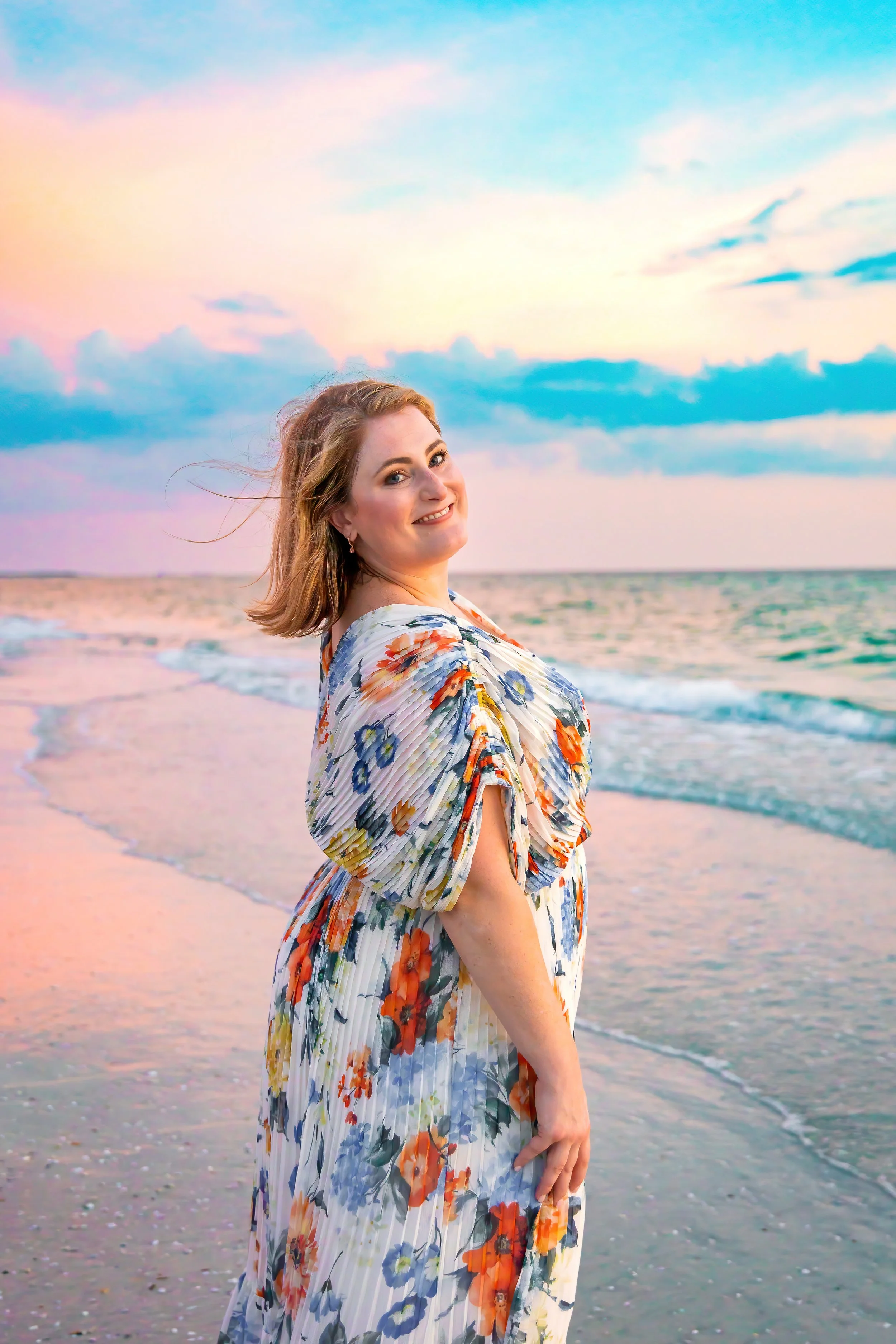
I'm a Florida transplant who has lived in several places throughout my life. Some of my earliest happy memories involve being near the water on Fire Island as a child, and the beach has remained my happy place ever since. I’ve developed a serious appreciation for the Gulf and its lovely sunsets.
I'm an animal lover and have two cats who are babied like they are humans. I would love a therapy dog, but my senior cat would have a lot to say about that.
I'm endlessly curious about people and how they become who they are—which probably explains both my career choice and my love of memoirs. I also read about psychology, history, and current events, and I'm usually planning my next concert or trip to see friends or family.
Outside of the more intellectual interests, I have a lifelong love of fashion, beauty, and art that I blame, at least partially, on my grandfather and our family's history in the shoe industry. I enjoy Pilates, yoga, good food, and walks on the beach.
And in the interest of full disclosure: my taste in television is considerably less academic than my bookshelf. I have been known to spend my free time analyzing the interpersonal dynamics of the Bravo Real Housewives. Apparently, my work never really leaves me.
Years ago, I would have told you all about my fantastic chicken parmesan and my love of cooking. These days, my husband does most of the cooking. I consider this personal growth.
Finding the Right Therapist Matters
You can read about a therapist's credentials, training, and approach, but ultimately, therapy involves sitting down with another human being and talking about parts of your life that may be difficult to share. Feeling comfortable with that person matters.
You don't need to know exactly what kind of therapy you need before reaching out. Part of my job is helping you understand your options, answering your questions, and figuring out together whether I—and the approaches I offer—are a good fit for what you need.
If you've made it this far, you probably know quite a bit about me by now. If you think we might work well together, I'd be happy to learn more about you.
Contact me to schedule a free, 20-minute consultation where we can talk briefly about what you're looking for, answer any questions you have, and determine whether working together feels like a good fit.